Today is a sad day for us. Sassy, our 8 1/2 year old Buff Cochen, passed away. She was a rescue chicken that became an integral part of our flock.
She did not walk fast or strong, but she got to where she wanted. The other hens knew that they would get their treats when Sassy got there. She was able to get her share of the food, too!
Sassy did not easily get out of the coop. Her old legs did not mind getting into the coop, but getting out was too much. So, every day, I picked her up and carried her out. She waited for me each day.
She was a gentle bird. My son called her Armor-All because of her feathers. The grandkids were fascinated by the feathers on her legs.
Sassy will be missed. She stole our hearts.
Showing posts with label backyard hens. Show all posts
Friday, July 19, 2013
Monday, April 1, 2013
Chicks First Day Outside
Our new chicks are five weeks old, so they are getting close to outside living. It is still chilly at nights, but the days have been quite warm.
Today, the chicks went outside for the first time. The other four hens showed interest right away. The chicks were quite wary.
However, the older girls lost interest soon. The Speckled Sussex stayed interested for just a couple minutes more.
The pullets are sticking quite close to each other. We will bring them into the house tonight.
Today, the chicks went outside for the first time. The other four hens showed interest right away. The chicks were quite wary.
However, the older girls lost interest soon. The Speckled Sussex stayed interested for just a couple minutes more.
The pullets are sticking quite close to each other. We will bring them into the house tonight.
Monday, March 25, 2013
Caring for Your New Chicks
When you get your chicks home from the post office or feed
store, they will need you to provide water, food, and warmth. Your chicks will be thirsty! As you place chicks into the brooder, dip
each chick's beak into the water. Make sure they drink. They will
tilt their little heads back and smack their beaks. This makes sure they
know how to drink, where to drink, and to drink.
After they have their first drink, set each chick next to your heat source. If you have an Eco-Glow contact brooder, nudge their little behinds under it. A contact brooder will allow the chicks to self-regulate their temperature and become used to the day-night cycle. If using a heat lamp, just set them down. Be sure to use an infra-red lamp, secure the lamp very carefully to prevent it from falling and causing a fire, and be careful not to overheat the chicks. Use a thermometer in the brooder at chick height. They should be 95 degrees during their first week, 90 their second, 85, and so on. Accomplish this by raising the heat lamp.
Use a feeder with little head-sized holes; this prevents them from scratching all of their food out onto the floor and into their litter. On the first day in the brooder, sprinkle some of the feed onto the paper towels to encourage them to eat. Place marbles or small rocks in their waterer. Chicks will do anything -- including falling asleep in their water. The marbles will help prevent drowning. Make sure they never run out of food or clean water. If you use a nipple waterer, make sure the water is away from the heat source.
Check the chicks’ bottoms every day for at least the first week and longer if you are having problems. You are checking for pasty butt, a result of physiological stress. Look for dried poop on their vent. If you find dried poop, soak their little behind in warm water. You can also use a warm wash cloth to loosen small bits of poop. Just picking it off might pull their feathers and skin. If your chicks have pasty butt, check to be sure that their water has vitamins or vinegar (1 tsp. per 1 gal.) and that the chicks have enough room and are not picking at each other. Be careful not to confuse the dried remnants of their umbilical with poop; leave the bit of umbilical. Their vents are higher up: Look down their back and then around their bottom, and the vent is the first opening you see. You may also see a pink bump near the end of their spine. That is their oil gland.
Also good to know:
from: scratchcradle.wordpress.com/
After they have their first drink, set each chick next to your heat source. If you have an Eco-Glow contact brooder, nudge their little behinds under it. A contact brooder will allow the chicks to self-regulate their temperature and become used to the day-night cycle. If using a heat lamp, just set them down. Be sure to use an infra-red lamp, secure the lamp very carefully to prevent it from falling and causing a fire, and be careful not to overheat the chicks. Use a thermometer in the brooder at chick height. They should be 95 degrees during their first week, 90 their second, 85, and so on. Accomplish this by raising the heat lamp.
Make sure the chicks have enough
room and clean litter. Give the chicks
1/2 a square foot each for the first two weeks and be prepared to increase this
to 2 square feet per chick by the third week.
Use a few inches of pine shavings on the floor. Do not use cedar;
the fumes are harmful to the chicks. Cover the shavings with paper towels
for the first three days to prevent them from eating the shavings
instead of their food. Check the
litter for damp spots a few times a day and remove the damp litter.
Change out large proportions of the litter daily.
Use a feeder with little head-sized holes; this prevents them from scratching all of their food out onto the floor and into their litter. On the first day in the brooder, sprinkle some of the feed onto the paper towels to encourage them to eat. Place marbles or small rocks in their waterer. Chicks will do anything -- including falling asleep in their water. The marbles will help prevent drowning. Make sure they never run out of food or clean water. If you use a nipple waterer, make sure the water is away from the heat source.
Check the chicks’ bottoms every day for at least the first week and longer if you are having problems. You are checking for pasty butt, a result of physiological stress. Look for dried poop on their vent. If you find dried poop, soak their little behind in warm water. You can also use a warm wash cloth to loosen small bits of poop. Just picking it off might pull their feathers and skin. If your chicks have pasty butt, check to be sure that their water has vitamins or vinegar (1 tsp. per 1 gal.) and that the chicks have enough room and are not picking at each other. Be careful not to confuse the dried remnants of their umbilical with poop; leave the bit of umbilical. Their vents are higher up: Look down their back and then around their bottom, and the vent is the first opening you see. You may also see a pink bump near the end of their spine. That is their oil gland.
Also good to know:
- Do not cook with any nonstick cookware while chicks are in your house. The fumes can kill them.
- Try never to brood a chick alone. Try to get another chick from a farm store or another owner. If you must brood alone, make sure to give the chick a lot of attention. Also, put a stuffed animal into the brooder for it to cuddle for comfort.
- Chicks are ready to live outside when fully feathered, at about six weeks. If it is warm during the day as well as the night, this can be sooner. If you want to put them outside in the winter, run electricity to the coop and use a contact brooder in the coop (or heat lamp with extra fire precautions.)
from: scratchcradle.wordpress.com/
Saturday, March 23, 2013
Sassy: Then and Now
The first picture was taken the day we brought Sassy home. She had been bullied and pecked by the rest of her flock. She had also been in isolation for three weeks. She looked scraggly; she was not emotionally a chicken.
The second picture is about eight weeks later. Her feathers are beautiful and fully grown in. She has completely joined the flock; she free ranges with the other girls all day long. She is very happy.
| Sassy the day we brought her home. |
![]() |
| Eight weeks later. |
Thursday, March 21, 2013
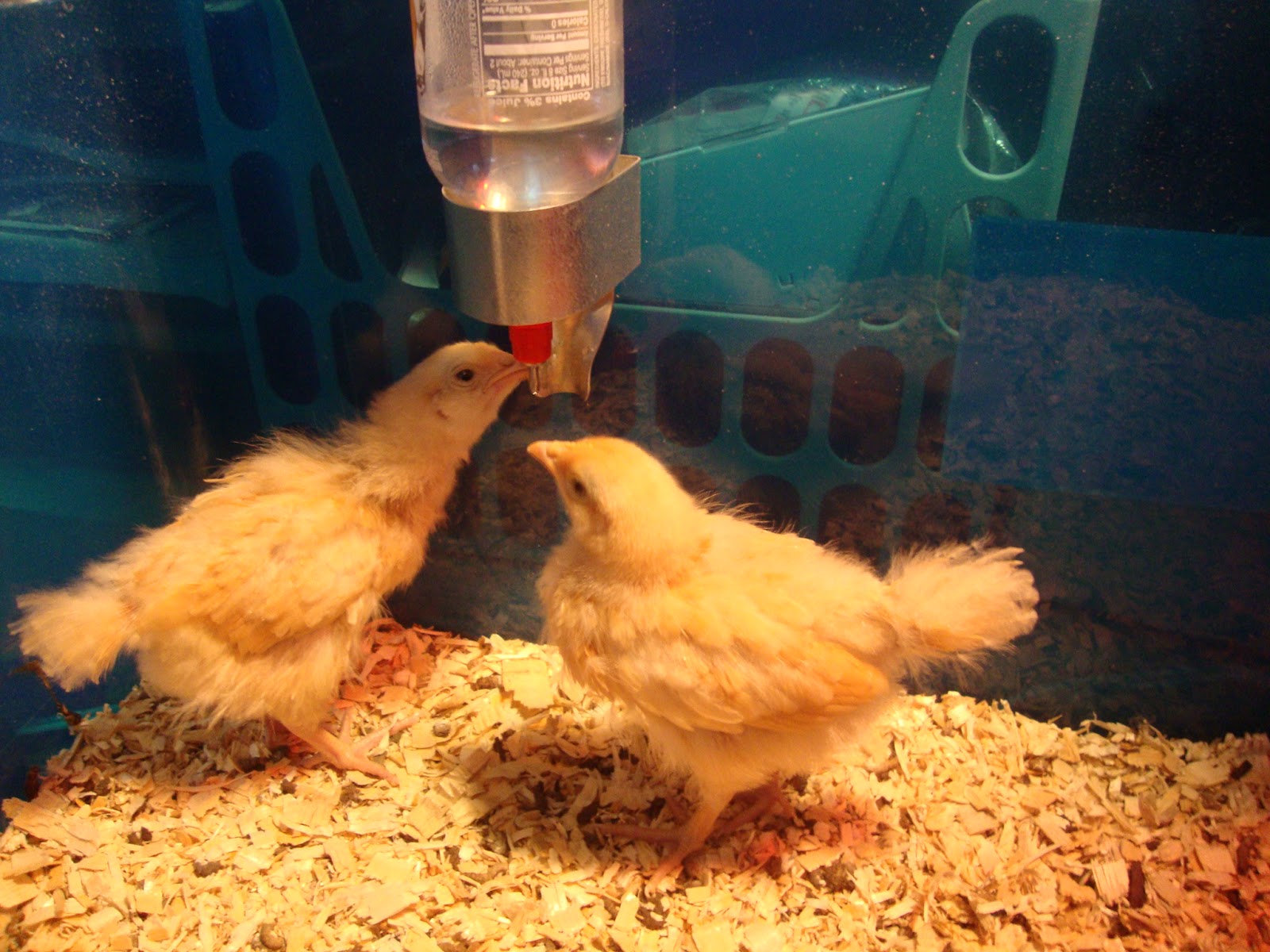
Chicks and the Nipple Waterer
I purchased two nipple waterers for the new chicks. I love, love, love them!
The nipples screw onto a soda bottle. I used a water holder for a hamster cage for one of the bottles, which has limitations of the same height in the brooder. The other bottle hangs from wire attached to the bottom of the bottle. I can adjust the height of this bottle.
The chicks peck the nipples instinctively. Both chicks drank from the nipples within five minutes.
Previously, I had used a traditional waterer. The water was dirty within minutes after changing it. There is no dirty water now. Clean water means less work for me. I like less work!
The nipples screw onto a soda bottle. I used a water holder for a hamster cage for one of the bottles, which has limitations of the same height in the brooder. The other bottle hangs from wire attached to the bottom of the bottle. I can adjust the height of this bottle.
The chicks peck the nipples instinctively. Both chicks drank from the nipples within five minutes.
Previously, I had used a traditional waterer. The water was dirty within minutes after changing it. There is no dirty water now. Clean water means less work for me. I like less work!
Labels:
backyard hens,
Chicks,
hens,
nipple waterer,
urban hens,
water
Wednesday, March 20, 2013
Pullets and Molting
| Sunny looks pretty scraggly right now. |
Molting is the process of shedding and renewing feathers. During the molt, the reproductive physiology of the bird has a complete rest from laying and the bird builds up its body reserves of nutrients. The provision of new feathers or a coat (a feature inherent in most animals) is a natural process, designed by nature to maintain a bird's ability to escape enemies by flight and better protect against cold winter conditions. Under usual conditions, adult birds molt once a year. Some may molt twice in one year and, rarely, once in two years.
The chick goes through one complete and three partial molts during its growth to point of lay. Generally, complete molting occurs from 1-6 weeks of age, and partial molting at 7-9 weeks, 12-16 weeks and 20-22 weeks. During this final molt, the stiff tail feathers grow.
Mature birds normally undergo one complete molt a year. The three main factors that bring about molting are:
- physical exhaustion and fatigue
- completion of the laying cycle (as birds lay eggs for a certain period of time)
- reduction of the day length, resulting in reduced feeding time and consequent loss of body weight.
If a bird stops laying and molting, this means its physical condition is deteriorating and, therefore, cannot support egg production, continued nourishment of their feathers or body maintenance. Feathers contain protein and are more easily grown when laying ceases because of the difficulty in assimilating sufficient protein for both egg and feather production. During the molt, the fowl still needs a considerable amount of good quality food to replace feathers and build up condition.
The time at which a laying hen ceases production and goes into molt is a reliable guide as to whether or not the hen is a good egg producer. Poor producing hens moult early and take a long time to complete the process and resume laying i.e. they 'hang' in the moult and are out of production for six to seven months. Poor producers seldom cast more than a few feathers at a time and rarely show bare patches.
High-producing hens moult late and for a short period (no more than 12 weeks), and come back into production very quickly. Rapid moulting is seen not only in the wing feathers of good producers, but also in the loss of body feathers generally. Because of this, it is common to see a late and rapid moulting hen practically devoid of feathers and showing many bare patches over its body.
Source: http://www.qld.gov.au/
Labels:
backyard hens,
chickens,
Chicks,
hens,
molt,
molting,
urban hens
Friday, March 15, 2013
Four Hens = Four Eggs
We have four hens. We have beem collecting an average of four eggs every two days.
Today -- the first day since last fall -- all four laid an egg! It has been so nice to have eggs again.
Sunday, March 10, 2013
Sonny and Cher
Sunny and Cher are our two new Buff Orpington chicks. Of course, we thought we were being so funny when we chose their names.
However, Cher is keeping her namesake's reputation intact. She sings long and loud and quite prettily. She is loveable and likes attention. She is very aptly named. Sunny makes the pair complete; they are always close to each other.
Who knew?
However, Cher is keeping her namesake's reputation intact. She sings long and loud and quite prettily. She is loveable and likes attention. She is very aptly named. Sunny makes the pair complete; they are always close to each other.
Who knew?
Saturday, March 9, 2013
My, They Grow Up So Fast!
Jakob was 15 months old when we got our first batch of chicks. Those hens are now full grown.
Our two new hens are doubling their size every day. Well, not really. But it seems like it.
Jakob, now two years old, loves his chickies. He stands by the brooder for hours, laughing and enjoying their antics. Soon, we may even let him hold one of them.
Our two new hens are doubling their size every day. Well, not really. But it seems like it.
Jakob, now two years old, loves his chickies. He stands by the brooder for hours, laughing and enjoying their antics. Soon, we may even let him hold one of them.
Thursday, March 7, 2013
Meet Sunny and Cher!
Our city ordinance allows six hens per backyard. We have four hens, so we were able to get two more chicks today. Enter Sunny and Cher!
We decided on two more Buff Orpingtons. This gives us three Buff Orpingtons, one Black Austrolorp, and two Speckled Sussex. What a great flock.
We just purchased bottle nipple waterers. Tomorrow I will get a bottle hanger. I hope it works because I hate how dirty the water gets.
We decided on two more Buff Orpingtons. This gives us three Buff Orpingtons, one Black Austrolorp, and two Speckled Sussex. What a great flock.
We just purchased bottle nipple waterers. Tomorrow I will get a bottle hanger. I hope it works because I hate how dirty the water gets.
Tuesday, March 5, 2013
Not a Typical Storm -- Oh, My!
The basket ball shows how the wind was blowing hard from the north. It was 60 degrees an hour ealier, then plummeted to 30 degrees.
We had 60 mph winds, hail, thunder, and snow. The storm lasted 30 minutes, even though it stayed cold for another day.
Many houses lost power; fortunately our power stayed on.
The chickens ran for their coop and safety as soon as the wind started.
What a freakish storm!
Labels:
backyard hens,
chickens,
hens,
snow,
storms,
urban hens,
wind
Friday, February 22, 2013
Picture of the Day 2/22/2013 Spring is Around the Corner
The weather is turning more spring-like instead of wintery. The girls are able to spend all day free-ranging in the yard.
So, I put the food back into the enclosure instead of the coop. The water will stay for a bit longer. The days are still not that long.
Every morning I have to take Sassy out of the coop. I think she has some arthritis that makes it difficult for her to go down the ramp. She does fine with going up the ramp, however.
Each morning, I open the doors and Sassy waits for me to pick her up and gently put her on the ground. Getting out of the coop is much healthier for her. Out of the coop, she can take her dust baths!
So, I put the food back into the enclosure instead of the coop. The water will stay for a bit longer. The days are still not that long.
Every morning I have to take Sassy out of the coop. I think she has some arthritis that makes it difficult for her to go down the ramp. She does fine with going up the ramp, however.
Each morning, I open the doors and Sassy waits for me to pick her up and gently put her on the ground. Getting out of the coop is much healthier for her. Out of the coop, she can take her dust baths!
Tuesday, February 19, 2013
Picture of the Day 2/19/2013 Sassy Runs as Fast as She Can
Sassy is eight years old. The other four hens in the flock will be one year old this spring.
Every day when I come home from work, I go out to visit the girls, do poo patrol, and give them an afternoon treat.
Since the flock knows that I come bearing treats, they all come running. Even Sassy. But Sassy doesn't run anymore -- she waddles along. At her own speed. And if there is snow in her way, she goes around it.
The other girls know that until Sassy gets there, they do not get their treats. They have not learned patience, but they know that Sassy will get there eventually.
Look how nicely Sassy's feathers have grown back. Such a pretty lady.
Every day when I come home from work, I go out to visit the girls, do poo patrol, and give them an afternoon treat.
Since the flock knows that I come bearing treats, they all come running. Even Sassy. But Sassy doesn't run anymore -- she waddles along. At her own speed. And if there is snow in her way, she goes around it.
The other girls know that until Sassy gets there, they do not get their treats. They have not learned patience, but they know that Sassy will get there eventually.
Look how nicely Sassy's feathers have grown back. Such a pretty lady.
Labels:
backyard hens,
chickens,
hens,
old,
treats,
urban hens
Wednesday, February 13, 2013
Picture of the Day 2/13/2013 Dust Baths
| Crystal |
Chickens love to take dust baths! They dig a shallow hole, loosen up all the dirt, and proceed to get themselves as dirty and dusty as they possibly can. They will often lay in the dirt on hot days to cool off.
Dust baths are a necessity for chickens. They prevent parasites such as mites and lice from finding a home in your chickens' feathers and legs.
If your chickens aren't free-range or their run area doesn't have a dry patch of ground where they can dig a hole, you'll need to provide them with an artificial dust bath. Place a box on the floor of their coop and fill it with 6" of a dusting powder. A typical recipe for the dusting powder: 1 part fireplace ashes, 1 part road dust, 1 part sand and 1 part diatomaceous earth.
Diatomaceous earth is a chalky power derived from the fossilized remains of microscopic plankton. Although not dangerous to the touch, diatomaceous earth contains silica, which, if inhaled, can lead to respiratory illness. If you choose to use it, make sure you research the dangers for you and your chickens.
Tuesday, February 12, 2013
Picture of the Day 2/12/2013 Garden for Chickens
Chickens
produce fertilizer, cultivate, and manage pests. As omnivores, they scratch the ground in
search of worms, insects, and seeds.
They also do not distinguish between my good plants and weeds. They will eat grass, weed, berries, fruits,
vegetables, and tender new greens. They
will eat whatever looks good. The only
sure way to protect your garden is to limit their freedom.
My
backyard has some spots that were weeds, but are now dirt. We found a moveable fence at a garage sale
last year, so we are planning to reseed some areas. I could plant lettuce, cabbage, alfalfa, mustard,
or kale as nutrient-rich greens. Seeds
and grains like buckwheat, clover, cow peas, and annual rye would be good
choices. Then, once the chicken garden is
mature, I can take down the fence and let the chickens feast. An added bonus, the chickens will turn the
garden spot into an enriched spot!
Some common plants can be toxic to
chickens, too, including daffodils, tulips, bleeding heart, bracken ferns,
delphinium, fireweed, foxglove, hyacinth, English ivy and nightshade. Lamb's
quarter, milkweed and St. John's wort are also poisonous, along with shrubs
from hydrangeas and Japanese yew to lantana and oleander. Inform yourself about
other possible toxic plants in your area and prevent your chickens' exposure to
these plants.
Be
there to supervise if you want your chickens' help with pest control in the
vegetable garden, because they won't distinguish between unwanted weeds and
precious seedlings.
Labels:
backyard hens,
chickens,
garden,
grass,
hens,
reseed,
urban hens
Monday, February 11, 2013
Picture of the Day 2/11/2013 Two Eggs!
We have just passed the ten-hours-of-daylight mark. We have been collecting one egg a day for a couple of weeks.
Today, however, we collected two eggs! Woohoo!
We have four consistent egg-layers and one 8-year old that lays occasionally. This summer should be a lot of eggs for our family.
Notice Patrick's ear. He got his ear pierced last weekend. He wanted to make sure his earring was in the picture.
Today, however, we collected two eggs! Woohoo!
We have four consistent egg-layers and one 8-year old that lays occasionally. This summer should be a lot of eggs for our family.
Notice Patrick's ear. He got his ear pierced last weekend. He wanted to make sure his earring was in the picture.
Thursday, February 7, 2013
Picture of the Day 2/7/2013 Young and Old Hens
| Yoda |
It's common for a hen in a backyard setting to live 8-10 years, but there are reports of chickens living as many as 20 years! The older they get, of course, the fewer eggs they lay, but think of all their other valuable functions besides being a loved member of the family. They still eat bugs and fertilize the earth.
Tuesday, February 5, 2013
Picture of the Day 2/5/2013 Chickens in the City
About a year ago, our city was developing the chicken
ordinance. Of course, the chicken haters
knew this would be the end of the world as we know it. However, the ordinance passed and no problems
have occurred. The permit for chickens
is $25 per year; permits for dogs are $6 per year. Yes, this is not fair. The coop has to be constructed 10 feet from
all public right of ways – for who knows what reason! But we complied with the rules. We have learned a lot in the last year and we
would do it all over again.
Mostly, I know that chickens belong in the city.
First, they lower stress.
Have you hugged your chicken today?
Great therapy!
Second, the chickens recycle food and yard waste, keeping it
out of the landfill. Then the food comes
out as nitrogen-rich fertilizer, which is then composted with other yard
waste. Win-win!
Third, the girls love to eat the bugs that I don’t
like. Box Elder bugs are no more. Mosquitoes are no more. They also eat weeds so I don’t need to use
any chemicals. Win-win!
Yes, chickens belong in the city. And I would do it all over again!
Monday, February 4, 2013
Picture of the Day 2/4/2013 Flock of Five
We had a flock of four just ten days ago. When we introduced Sassy to the flock, the sweet, gentle original four accepted her right away.
Sassy did not know how to behave around hens that would let her eat her share and not pick on her. Sassy showed aggression a couple of times, but our original four allowed her to be in the flock.
Now, the flock of five have gotten used to each other. Sassy is not showing aggression towards the others; she found that it was not necessary.
What a great flock of five!
Notice how gray the day is. The temperature is in the 40s, but the wind is howling. Brrr... The wind chill doesn't seem to bother the girls.
Sassy did not know how to behave around hens that would let her eat her share and not pick on her. Sassy showed aggression a couple of times, but our original four allowed her to be in the flock.
Now, the flock of five have gotten used to each other. Sassy is not showing aggression towards the others; she found that it was not necessary.
What a great flock of five!
Notice how gray the day is. The temperature is in the 40s, but the wind is howling. Brrr... The wind chill doesn't seem to bother the girls.
Saturday, February 2, 2013
Picture of the Day 2/2/2013 Sassy's Egg
Right now we have only one of our five hens laying. Crystal has been one of our most consistent layers.
However, I went out yesterday, and found an egg under Sassy. Sassy is eight years old and just joined our flock, but she is still laying! Which means, two of our hens are laying. Woohoo!
We are soon approaching our ten-hour day, so we should see egg production up soon.
However, I went out yesterday, and found an egg under Sassy. Sassy is eight years old and just joined our flock, but she is still laying! Which means, two of our hens are laying. Woohoo!
We are soon approaching our ten-hour day, so we should see egg production up soon.
Subscribe to:
Posts (Atom)